
From the post-war avant-garde art movements of the 20th century to the present day, for art, the human factor is not necessarily subordinated to manual skills. AI art and NFT generative art projects are no exception either.
Given the exponential development of generative AI in recent years, between 2021-2023 there has been an implosion in the popular use of AI for the creation of various NFT collections that have been noticed in dissimilar 1/1 art platforms such as Foundation, Superrare, Objtk, etc. Likewise, the advent of various ai communities of artists on the Internet who share their creations on social media such as Mastodon, X (Twitter), Meta (Instagram, Facebook), and Discord, have been notorious for adopting a category such as #aiartists as a distinction that invites a larger community to join and explore the possibilities and dangers that this disruptive technology brings to the world.
Although this tool has reactivated the already existing discomfort in the artistic communities (the ArtStation cases and the protests in Hollywood against the firing of screenwriters), the use of generative tools for the creative industry and the art system has been a constant in the digital artistic practices that have been taking shape within the art field since the appearance of the computer artifact around the second half of the twentieth century until the present day. (Examples: the experiments of generative artists such as John Whitney and Vera Molnar with analog computers, the new media art of the 1990s, festivals such as Ars Electronica, etc.).
Despite the role relationship between intelligent machines and humans in terms of capabilities and values (if quantification of work time and creativity is taken into consideration), this role relationship continues to raise controversies in social circuits, questioning strategies and structures used for fields such as the cultural industry, education and work as we know them. The expansion of generative AI tools has been awakening old philosophical questions related to the essence of creation itself that have preoccupied art and social sciences for several decades.
The intersections between Generative Art, Artificial Intelligence and NFT have similar points that connect them in some processes, and although they have different levels of interaction, all three share a common element, which is that they need the human factor to emerge and emancipate themselves.
To think about AI and generative NFT art projects – where we are and where we go?
Therefore, to get into the subject, it is important to analyze the particularity of each of these branches together with the slight changes that the NFTs introduced in the artistic circuit.
To do so, we will divide the concepts that accompany us and their considerations within the contemporary visual arts:
- Generative art
- Artificial Intelligence
- NFT art
- Discussions between contemporary art and fine arts in terms of manual skills.
Generative Art:
“Generative art refers to any art practice where the artist uses a system, such as a set of natural language rules, a computer program, a machine, or other procedural invention, which is set into motion with some degree of autonomy contributing to or resulting in a completed work of art.”1
When we study the processes that influence the definition of what is considered generative art, an idea is constant within its various positions, generative art dialogues with the conjunt of epistemic and technical relationships that interfere in the systems from which it emerges.
Closely linked to studies of complexity theory, generative art seeks to find the state resulting from the conjunction of the processes of order (control-perfection) and disorder (chaos-error) existing both in matter and in behavior. The symbiosis between both states through the exploration and manipulation of their flows and relationships are ways of approaching theories on how complexity works. For generative art these processes are essential through experimentation between shapes and algorithms to become moderately controlled outputs. For generative art, it is essential to find that midpoint that emerges from the symbiosis between chaos and order that emerge within a system. For generative artists that is the origin of creation itself. Both, short-form generative art and long-form generative art, work with this principle.

Differences between the short-form and the long-form,
While the former is the artist who controls the results of the generative process through the prior selection of the output (final result), in the long-form the output is an uncertainty that is revealed in the exact moment in which the minter (collector) buys and generates the artwork. It adds a poetic condition, it extends the factor of uncertainty until the last moment.
Artificial intelligence:
We tend to see artificial intelligence from various states, among which are the view coming from the cultural industry: cinema, literature, art, and music, whether in a post-apocalyptic or transhumanist sense. The view from the scientific pragmatic study: machine learning, generative AI, robotics, computer engineering, etc. It is also being viewed from a philosophical way (it could be the breeding ground for thinking about other epistemologies and ways of understanding matter and creative processes). Although this idea of an intelligent machine comes from a series of investigations from the end of the 19th century with Ada Lovelance, (mother of the algorithm), investigations rescued by Alan Turing around 1930 (considered the precursor of AI), whose foundations spread until this day.
Beyond its scientific nature, generative AI as a tool has been gaining ground in popular culture due to its faster capacity for adaptability and response through generative processes and prompts. NFT art, as a digital phenomenon, is compatible with generative AI tools since both (NFT and AI) belong to the so-called disruptive technologies.
However, questions related to the essence of creation (capacity that was added only to humans) have been put to questioning for their impact on common culture and Internet communities. This implosion of creative tools with easy access to the public outside the art system put in crisis some myths of art and the character of the artist settled in the popular minds since the Modern Age for a wider public. This context points to the need for an epistemological reform in terms of artistic culture.
Despite the sides, emerging generative AI tools offer several challenges and opportunities for artists consistent with an accelerating technologized society.
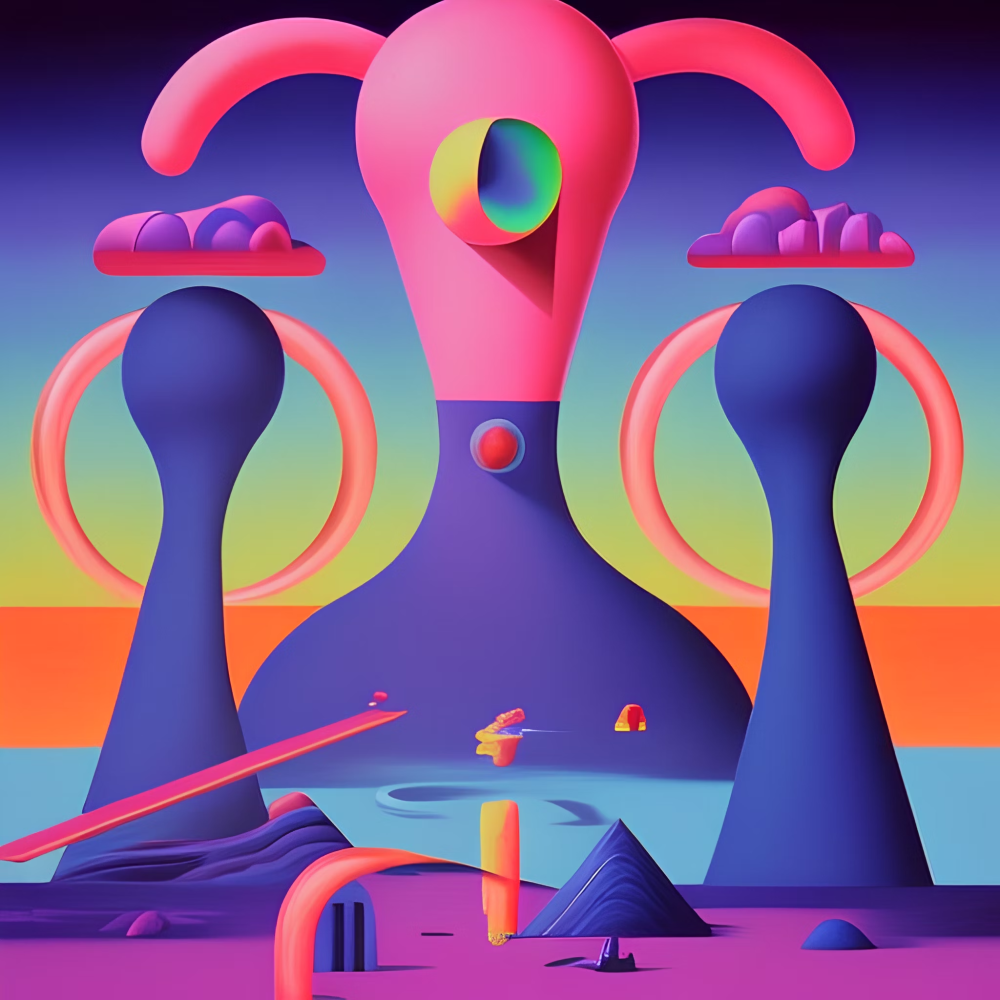
For artists, AI provides:
- Publicly accessible tool. Most of these AIs are accessible, which facilitates creative experimentation and exploration.
- However, this open access has a subversive side: the source information that the AI uses to generate content is a recycling of the same information that we upload to the Internet. Furthermore, we are the people who train and optimize the AI with our interactions and we are not being paid for that work time, which means that AI companies are using our data to train the AI while we are using their services by paying a fee.
- Saves time in production processes. It reduces technical work time that can be applied to other creative processes. However, there are some consequences of using this tool in an inadequate way, which are:
- Homogenization of the style (similar aesthetics are reproduced) which leads to a subtle loss of aesthetic-visual diversity if it is used without a clear intention.
- Pressure to meet demand (audience) or FOMO. The economy of time in production cycles has become a necessity and demand of cultural industries towards artists as a consequence of technological and market accelerationism. As a result, creators are looking for tools that enable them to satisfy a large quantitative demand in the shortest possible time. This symptom can be observed both in the creative industries and in the public that demands them.
- Image seduction. (According to the philosopher Baudrillard (1981) seduction originates at the moment when you discover in the other what is missing in you). Commonly, we are fascinated by the responsiveness of AI in its generative processes, for example when suggestive images are generated from a prompt with natural language (which requires machine learning), we get excited because we know that computers do not operate with the language used by humans. That surprise factor seduces us and makes us spend hours generating variations of our creations until we are satisfied with our desires.
- Search for self-confirmation. In this case, we unconsciously expect to find in the AI’s answers what reaffirms our vision of things, tastes, ethics and preferences, or simply what best suits our idea (development of environments for a storyboard, characters, etc.).
These four points have in common that they are purely human concerns and needs.

Disadvantages of AI:
The AI we know today, lacks the complex abstract thinking necessary to exercise human operations and analysis in culture and society (e.g., taking into account subjective processes such as emotions and senses, contextual processes such as cultural traditions, political contexts, idiosyncrasies; improvisation, etc.), this abstract thinking is an essential component in the creative processes and analysis of art. The prompt and the algorithm are not enough to make art because other processes and conditions are needed, even human intervention is necessary for the final judgment.
AI saves time in production processes because it generates acceleration and quantity. However, since it lacks the complexity needed to develop processes as complex and abstract as artistic creation itself, it is important to consider this tool as a support resource for creators to do their work and not as an absolutist approach.
NFTs
The very creation of an NFT is essentially generative, if we analyze its technical structure, the token is generated by minting a file x on the blockchain. This action (minting) starts from a random process (hash generation) and a controlled action (smart contract), previously programmed and guarded by a series of individuals who are in charge of maintaining the algorithms and hardware.
In the field of art with the emergence of NFTs, digital art recovers the (Benjaminian) aura of the work of art due to its condition of scarcity. A condition that, according to Benjamin, had been lost when the work of art dialogued with mass media distribution and technical reproducibility in the 20th century, unlike the classical work of art that was more privative. In other words, there has emerged an interest in digital art collecting that is also interested in its different channels of distribution and circulation. These channels remain disruptive to the art system, even as auction houses such as Christie’s and Sotherby’s and international art fairs such as Art Basel and the Venice Biennale have made use of these digital assets for marketing purposes.
[NFT = provenance + authorship/s (collaborators) + proof of work + uniqueness (original) + ownership + technological security (storage and maintenance)].
A relation between contemporary art and technic
Since the appearance of the photographic camera and modern science, for modern visual arts, the craft of the artist is no longer visible as a crucial factor in determining the quality of the work of art. For contemporary art (post-war 1950 – 2023) this idea overflows its limits, since the human factor can be considered for the right to choose and select both the materials and the context, for its production. These processes of choice and selection go from the aesthetic, intellectual, and contextual values that will dictate the process of materialization of the work of art, being in most cases the elaboration of the artistic object (image, sound, etc.) unnecessary to be carried out by the artist who thinks it. Art becomes above all a complex intellectual process. This idea dismantles the myth of the artist as a genius locked in the studio to become a subject of relational intersections.
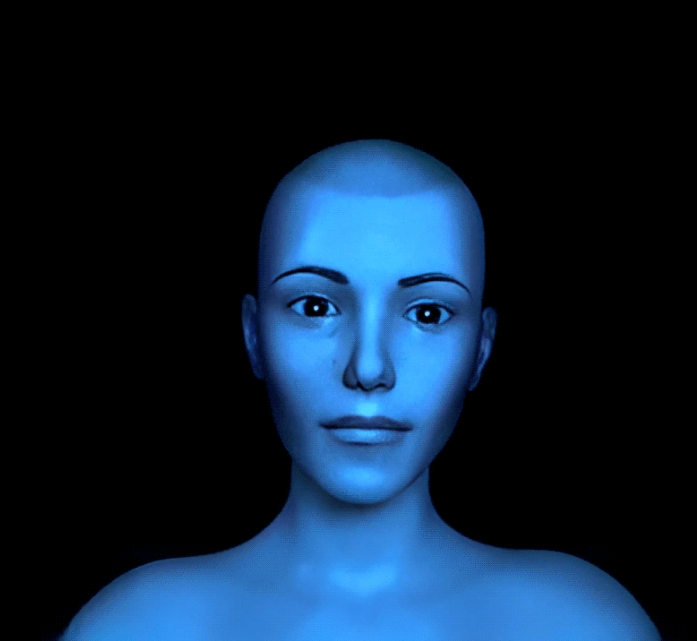
iNFT // To the Young Artists of Cyberspace
In summary:
We cannot assume that every production made with generative tools, whether by prompt or algorithmic writing, is devoid of human essence, nor can we claim that all NFT projects using these tools are considered art because of the simple execution of the technique (manual technical skills). A good work of art goes beyond the visible, to the logic of form or knowledge.
Both AI and generative art begin with an intellectual process that is generated in the human mind itself, which is externalized through the exploration of the environment around us, our references as well as our experiences.
Therefore, the question is not whether these ways of making are art or not by the fact of how it has been generated (whether by computer or by a person); it becomes art in how we learn to select, remix, and transform matter using our skills and tools to generate sublime content.
Making a good NFT art project, whether generative or AI, will depend on the questions we ask ourselves, the references we consult, and the time and passion we put into the creation process. As a creator, you have to be aware of the particularities that the medium offers to take it to other levels of artistic development with critical thinking and passion. These technologies will be just the beginning to develop NFT projects, AI art and quality generative art in the future. There is still a lot to do.
Notes
- Philip Galanter, What is Generative Art? Complexity Theory as a Context for Art Theory, 5 ↩︎
Bibliography
Sterpi, M. A. S. S. I. M. O. (2022). La disrupción del arte: arte y tecnología en el siglo XXI. Revista Jurídica de Buenos Aires, 46(103), 17-35.
 AISSA SANTISO